
Two-Stroke Engine tolerances: How Compounding Tolerances Affect Squish Clearance, Port Timing, and Performance
Why having the complete engine matters more than most riders realize
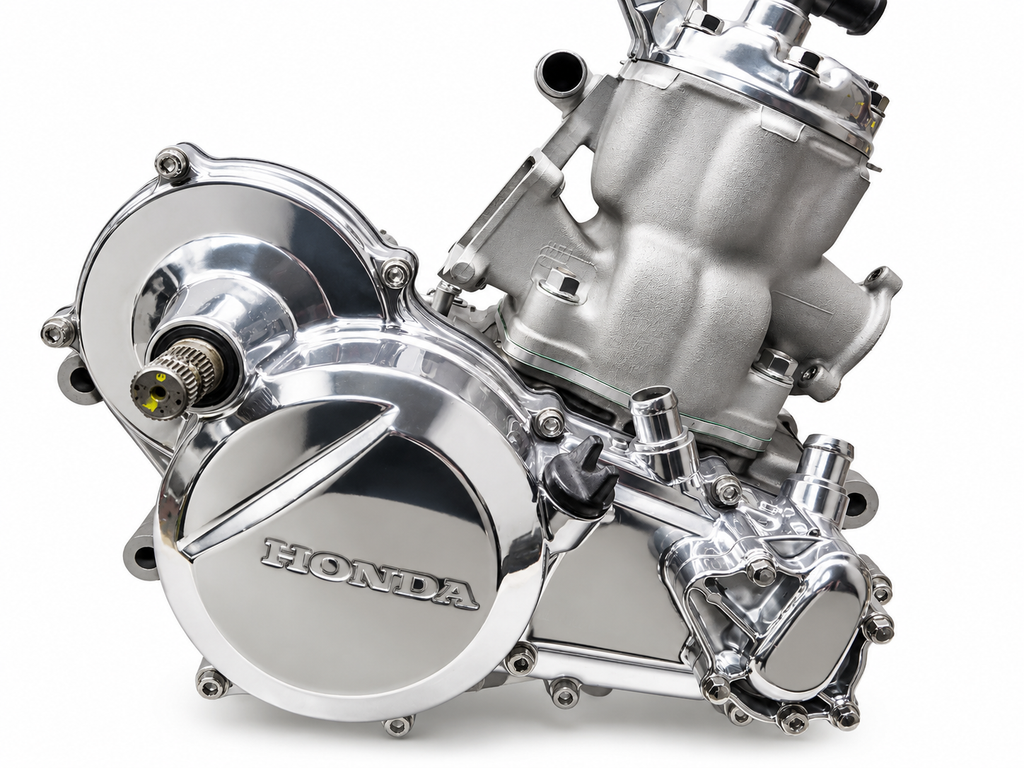
When it comes to building a two-stroke engine, there’s a big difference between machining individual components and building an engine as a complete, properly measured assembly.
At Ken O’Connor Racing, we frequently receive cylinders, cylinder heads, crankshafts, and other individual engine components for machine work. While we can certainly perform these services individually, there is a significant advantage to having the complete engine in our shop.
The reason comes down to something many riders, and even some engine builders, overlook: tolerance stacking.
Every component in an engine has manufacturing tolerances. Individually, those tolerances may seem insignificant. But when multiple components are assembled, their dimensional variations can add together or cancel each other out, changing the final geometry of the engine.
In a two-stroke engine, those differences directly affect squish clearance, compression ratio, port timing, combustion efficiency, and ultimately, how the engine performs.
What Is Tolerance Stacking?
No two engine components are manufactured to exactly the same dimensions.
Even factory OEM parts have acceptable dimensional variations. Aftermarket parts introduce additional variations, and engines that have been rebuilt or modified may have dimensions that differ substantially from factory specifications.
Consider some of the components that determine the position of the piston in relation to the cylinder and cylinder head:
- Crankshaft stroke
- Connecting rod center-to-center length
- Piston compression height (wrist pin center to piston crown)
- Crankcase cylinder mounting height
- Cylinder base gasket compressed thickness
- Cylinder height from its mounting surface to its head gasket surface
- Cylinder head gasket compressed thickness
- Cylinder head squish band geometry
Each component contributes to the final assembled dimensions.
A crankshaft with slightly more stroke, a connecting rod that is slightly longer, or a piston with a greater compression height can all move the piston closer to the cylinder head at top dead center.
Conversely, a thicker base gasket, a shorter connecting rod, or a piston with a lower compression height can move the piston farther away.
The important point is that these differences don’t disappear when the engine is assembled. They become part of the finished engine’s geometry.
And unless the complete assembly is measured, the machinist may have no way of knowing their combined effect.
How Tolerance Stacking Affects Squish Clearance
Squish clearance is one of the most important measurements in a performance two-stroke engine.
It is the minimum distance between the piston crown and the cylinder head’s squish band as the piston approaches top dead center.
The squish band forces part of the trapped air-fuel mixture toward the combustion chamber, creating turbulence that promotes combustion.
Proper squish clearance and squish band geometry can improve combustion efficiency, throttle response, and resistance to detonation.
Incorrect squish clearance can create serious problems.
Too much squish clearance can reduce the effectiveness of the squish band, weaken mixture turbulence, and leave combustion efficiency on the table.
Too little squish clearance can allow the piston to contact the cylinder head under operating conditions as components expand, stretch, and deflect at high RPM.
Squish clearance must account for more than the static measurement. Connecting rod stretch, bearing clearances, piston rock, thermal expansion, and operating RPM all influence the minimum safe clearance.
A Realistic Example of Compounding Tolerances
Consider a hypothetical two-stroke engine with the following dimensional differences from the nominal measurements:
| Component | Effect on piston-to-head clearance |
|---|---|
| Crankshaft stroke increased by 0.10 mm | −0.05 mm |
| Connecting rod length increased by 0.05 mm | −0.05 mm |
| Piston compression height increased by 0.10 mm | −0.10 mm |
| Cylinder base gasket 0.10 mm thinner | −0.10 mm |
| Head gasket 0.05 mm thinner | −0.05 mm |
| Total change | −0.35 mm |
The increased stroke contributes half its dimensional change at TDC because crank radius is half the stroke.
In this example, the assembled engine would have 0.35 mm less piston-to-head clearance than expected from the nominal dimensions.
If the cylinder head had been machined for a nominal 1.00 mm squish clearance, the actual assembled clearance could be approximately 0.65 mm, assuming the other relevant dimensions and squish geometry match the design.
That’s a substantial difference.
Depending on the engine, piston, RPM, and operating conditions, it could create an unacceptable risk of piston-to-head contact.
Now imagine those tolerances stacking in the opposite direction.
The engine could end up with considerably more squish clearance than intended, reducing the effectiveness of an otherwise carefully machined cylinder head.
This is why machining a cylinder head without measuring the actual engine assembly involves assumptions.
The machinist can produce an accurately machined head, but accurate machining alone does not guarantee the desired installed squish clearance.
How Tolerance Stacking Affects Two-Stroke Port Timing
Squish clearance is only half the story.
The same dimensional variations that affect piston position also affect the relationship between the piston and the cylinder ports.
In a two-stroke engine, the piston controls the opening and closing of the exhaust and transfer ports.
Port timing is measured in crankshaft degrees and determines when these ports open and close during the engine’s operating cycle.
Unlike a four-stroke engine, where camshaft timing controls valve events, a conventional piston-ported two-stroke relies on the physical relationship between the crankshaft, connecting rod, piston, and cylinder ports.
Small dimensional changes can alter that relationship.
Cylinder Base Gasket Thickness
Changing the cylinder base gasket thickness is one of the easiest ways to demonstrate this effect.
Installing a thicker base gasket raises the cylinder relative to the crankshaft.
That changes the relationship between the piston and the port roofs.
Generally, raising the cylinder causes the exhaust and transfer ports to open earlier and close later, increasing their duration in crankshaft degrees.
Lowering the cylinder generally produces the opposite effect.
But there’s another consequence.
Raising the cylinder also increases the piston-to-head distance if the cylinder head moves upward with it.
That means a base gasket change intended to alter port timing can also change squish clearance and compression.
You cannot assume that changing one dimension affects only one aspect of engine performance.
Everything is connected.
Crankshaft Stroke and Connecting Rod Length
Crankshaft stroke and connecting rod length determine the piston’s position throughout the crankshaft’s rotation.
Changing either one can alter the relationship between piston position and crankshaft angle.
A longer connecting rod, for example, changes piston motion relative to crank angle, even when stroke remains unchanged.
A stroker crankshaft changes both piston travel and the relationship between the piston and the ports.
This is particularly important when building modified engines using stroker crankshafts, aftermarket pistons, or custom cylinder machining.
Installing a stroker crankshaft without correcting the cylinder geometry can change port timing, piston deck height, and squish clearance.
Simply adding a spacer plate or thicker gasket may solve one dimensional problem while introducing another.
The entire combination needs to be evaluated.
Why Porting a Loose Cylinder Has Limitations
When a customer sends us only a cylinder for porting, we can measure the bore, inspect the port layout, and machine the ports according to a specific design.
We can also use the intended crankshaft stroke, connecting rod length, and piston dimensions to calculate nominal port timing.
However, unless the actual assembled dimensions are known, those calculations rely on assumptions.
Consider two Yamaha Blaster engines using what appear to be identical cylinders.
One engine may have an original OEM crankshaft, connecting rod, piston, and factory cylinder dimensions.
The other may have a rebuilt crankshaft, an aftermarket connecting rod, a different piston, a replacement base gasket, and a cylinder that has previously been machined.
Even if both cylinders are ported to identical measured port heights, the assembled engines may not have identical port timing.
This becomes particularly important with aggressive trail, motocross, dune, and race porting.
A small change in exhaust duration or transfer timing can affect where an engine develops its power.
Port timing also determines blowdown angle, the crankshaft rotation between exhaust opening and transfer opening.
Blowdown influences the time available for cylinder pressure to decrease before the transfer ports begin delivering the fresh charge.
Changing the relationship between exhaust and transfer timing can change the engine’s power characteristics.
The more aggressive the engine combination, the more important accurate measurements become.
Cylinder Deck Height: The Measurement That Connects Everything
One of the most important measurements during engine assembly is piston deck height.
Deck height describes the piston’s position relative to the cylinder’s head mounting surface at top dead center, using a clearly defined piston reference point.
The piston may sit below the cylinder deck, flush with it, or protrude above it.
That measurement is determined by the combined dimensions of the crankshaft, connecting rod, piston, crankcases, cylinder, and base gasket.
It is also one of the key measurements needed when designing a cylinder head.
If the piston sits farther below the cylinder deck than expected, the head’s installed squish clearance will generally increase.
If the piston sits higher, squish clearance will generally decrease.
For domed pistons, the shape and angle of the piston crown must also be considered.
A cylinder head machined for one piston design may not produce the intended squish band clearance or geometry when used with a different piston.
This is why we prefer to know the exact piston being used when performing performance cylinder head machining.
Piston diameter alone is not enough.
Squish Clearance and Compression Ratio Are Not the Same Thing
Another common misconception is that setting squish clearance automatically establishes the correct compression ratio.
It doesn’t.
Squish clearance and combustion chamber volume are related, but they are separate measurements.
Two cylinder heads can have identical squish clearance and completely different combustion chamber volumes.
Likewise, two heads can have the same measured chamber volume but different squish band widths, angles, and clearances.
In a two-stroke engine, compression is also influenced by the exhaust port closing point.
Raising the exhaust port delays its closing, reducing the portion of the compression stroke during which the charge is trapped.
This changes the effective compression process.
Consequently, cylinder head design should take into account:
- Engine displacement
- Exhaust port timing
- Actual piston deck height
- Piston crown geometry
- Combustion chamber volume
- Squish band width and angle
- Intended operating RPM
- Fuel octane and engine application
A cylinder head intended for a stock trail engine should not automatically be considered suitable for an aggressively ported race engine simply because both engines have the same bore diameter.
The cylinder head and porting should be designed to work together.
Why Cutting the Cylinder Base or Top Changes More Than One Measurement
Machining the cylinder base and machining the top of the cylinder are two different operations with different consequences.
Cutting the Cylinder Base
Removing material from the cylinder base lowers the cylinder relative to the crankshaft.
This generally reduces exhaust and transfer port duration and moves the piston closer to the cylinder head at TDC.
It also changes the port positions relative to the piston at bottom dead center.
Cutting the Top of the Cylinder
Removing material from the cylinder’s upper deck changes the cylinder’s overall height and the installed relationship between the piston and cylinder head.
However, it does not directly change the position of the exhaust and transfer ports relative to the crankshaft.
Therefore, cutting the top of the cylinder can be used to alter deck height and head position without directly changing port timing.
Both operations can be useful during engine building, but they are not interchangeable.
The correct machining operation depends on what the engine actually needs.
The Importance of Measuring Port Timing on the Assembled Engine
Port timing can be calculated from accurate engine geometry, but the best way to verify actual timing is to measure the engine.
With the crankshaft, connecting rod, piston, cylinder, and intended base gasket assembled, port opening and closing events can be checked using a degree wheel and a repeatable measurement method.
This allows us to verify actual exhaust and transfer timing rather than relying entirely on catalog specifications or assumed dimensions.
We can then compare the measured timing against the intended application.
For example, an engine intended for technical trail riding may benefit from a different port timing combination than an engine designed to make maximum horsepower at high RPM.
A properly designed engine isn’t necessarily the one with the highest exhaust port or the most aggressive porting.
It’s the one with the correct combination of port timing, compression, squish geometry, intake, exhaust, and intended operating range.
Why Having the Complete Engine Is the Better Approach
When we have the complete engine at Ken O’Connor Racing, we can evaluate the actual combination instead of making assumptions about individual components.
We can measure piston deck height, verify crankshaft stroke, check actual port timing, measure squish clearance, and evaluate the relationship between the cylinder and cylinder head.
We can also inspect components for wear, damage, and previous machine work that may affect the final dimensions.
This gives us the opportunity to correct dimensional problems before the engine is completed.
For example, if the port timing is where we want it but squish clearance is excessive, we can evaluate machining the cylinder’s upper deck or modifying the cylinder head rather than automatically changing the base gasket thickness.
If the squish clearance is correct but the port timing needs adjustment, we can address the port geometry without unnecessarily disturbing the established cylinder position.
If both are incorrect, we can determine the proper combination of machining operations to bring the engine closer to the intended specifications.
The goal is to make every component work together as a system.
That’s the difference between machining parts and building an engine.
Can You Still Send Individual Components for Machine Work?
Absolutely.
We perform cylinder boring, cylinder porting, cylinder head machining, crankshaft rebuilding, and other machine work on individual components every day.
There are many situations where sending only the cylinder, head, or crankshaft makes perfect sense.
A routine cylinder bore on an otherwise stock engine, for example, does not necessarily require the complete engine.
But when a customer wants a performance build with carefully controlled port timing, compression, and squish clearance, having the complete engine provides a significant advantage.
If sending the complete engine isn’t practical, providing accurate measurements and information about the actual components being used can help reduce uncertainty.
The important thing is understanding the difference between machining a part to a specified dimension and verifying that dimension in the final assembled engine.
The Bottom Line: Precision Engine Building Requires More Than Precision Machining
A machinist can hold extremely tight tolerances while machining a cylinder or cylinder head.
But that doesn’t mean the finished engine will automatically have the intended dimensions.
The machine work can be perfect, yet the assembled engine can still have incorrect squish clearance, compression, or port timing because of dimensional variations elsewhere in the assembly.
That’s why tolerance stacking matters.
And that’s why, whenever possible, we recommend sending the complete engine when having performance machine work performed.
At Ken O’Connor Racing, we don’t believe in blindly machining components to generic dimensions and assuming everything will work perfectly once they’re assembled.
We believe in measuring, understanding, and correcting the complete combination.
Because the engine doesn’t care how accurately one individual part was machined.
It only knows the dimensions it ends up with when everything is bolted together.
Professional Two-Stroke Engine Machining and Rebuilding
Ken O’Connor Racing specializes in professional two-stroke engine machining, cylinder boring, porting, cylinder head modifications, crankshaft rebuilding, and complete engine assembly.
Whether you’re rebuilding a stock Yamaha Blaster or putting together a custom high-performance two-stroke engine, we can help you get the combination right.
We accept shipped engines and individual components from customers throughout the United States.
Ken O’Connor Racing — Danielson, Connecticut
Website: https://kenoconnorracing.com
Engine services: https://kenoconnorracing.com/services/
Mail-in Yamaha Blaster engine rebuilding: https://kenoconnorracing.com/mail-in-yamaha-blaster-engine-rebuilding/