
Yamaha Blaster Cylinder Identification Guide: OEM, CT Racing, Airsal, Vito’s, and Chinese Cylinders
By Ken OConnor Racing | Yamaha YFS200 Blaster Technical Guide
Not all Yamaha Blaster cylinders are created equal. Over the years, several manufacturers have produced replacement and high-performance cylinders for the Yamaha YFS200 Blaster. Some were designed as inexpensive replacements for the factory cylinder, while others were purpose-built racing cylinders capable of producing substantially more horsepower.
Today, some of these cylinders are highly sought after by collectors and performance enthusiasts. Others are still readily available, but their quality, construction, and performance potential vary considerably.
At Ken OConnor Racing (KOR), we’ve worked with factory Yamaha cylinders, aftermarket big-bore kits, and imported replacement cylinders for years. Understanding the differences is important, especially when purchasing a used engine, planning a rebuild, or trying to identify a cylinder that has been modified by a previous owner.
This guide covers the major Yamaha Blaster cylinder variations, how to identify them, their advantages and disadvantages, and which ones are worth keeping.
Yamaha Blaster cylinder identification chart
| Cylinder | Bore | Approx. displacement* | Identification |
|---|---|---|---|
| Yamaha OEM Y-1 | 66 mm | 195 cc | Y-1 casting |
| Yamaha OEM Y-2 | 66 mm | 195 cc | Y-2 casting |
| CT Racing Sonic | 66 mm | 195 cc | Special racing casting and port layout |
| CT Racing Sonic | 72 mm | 232 cc | Racing casting, large bore |
| Airsal | 66 mm | 195 cc | Aftermarket cylinder, Airsal marked on casting |
| Airsal | 71 mm | 226 cc | Larger bore, Airsal marked on casting |
| Vito’s Performance | 72 mm | 232 cc | Big-bore cylinder, auxiliary exhaust ports |
| Sleeved Yamaha OEM | 72 mm | 232 cc | Factory exterior, enlarged sleeve |
| Chinese OEM-style | Typically 66 mm | 195 cc | OEM-style casting, generally no Y-1/Y-2 |
Displacements assume the factory 57 mm stroke. The commonly used 240cc designation is a product-class name; a 72 mm bore with the factory stroke actually displaces approximately 232 cc. Long-stroke crankshafts change these figures.
1. Original Yamaha OEM cylinders: Y-1 and Y-2

The original Yamaha cylinder remains one of the most desirable choices for riders looking for reliability, durability, and a strong foundation for performance modifications.
Factory Yamaha Blaster cylinders use an aluminum casting with a cast-iron cylinder liner. The original bore is 66 mm, and the factory displacement is 195 cc.
How to identify an OEM cylinder
Look for the following characteristics:
- Y-1 or Y-2 casting identification near the reed-valve intake area.
- Factory displacement markings, typically
195 cm³. - Original Yamaha-style cooling fins and cylinder exterior.
- Conventional factory intake and exhaust port configuration.
- A cast-iron sleeve that can be bored for oversized pistons up to 66.25mm.
The Y-1 and Y-2 markings are especially useful when distinguishing an original Yamaha casting from a Chinese replacement.
What’s the difference between Y-1 and Y-2?
Both are recognized factory Yamaha Blaster cylinder castings. There is no well-established evidence that one is inherently a higher-performance cylinder than the other.
Some riders believe the Y-2 is an improved or more powerful version, but the casting designation alone does not establish that.
KOR recommendation: Choose an OEM cylinder based on its actual condition, remaining sleeve thickness, bore size, and porting quality rather than the Y-1 or Y-2 marking.
A clean, unmodified OEM cylinder with plenty of remaining bore life is particularly desirable.
2. CT Racing Sonic cylinders: 66 mm and 72 mm
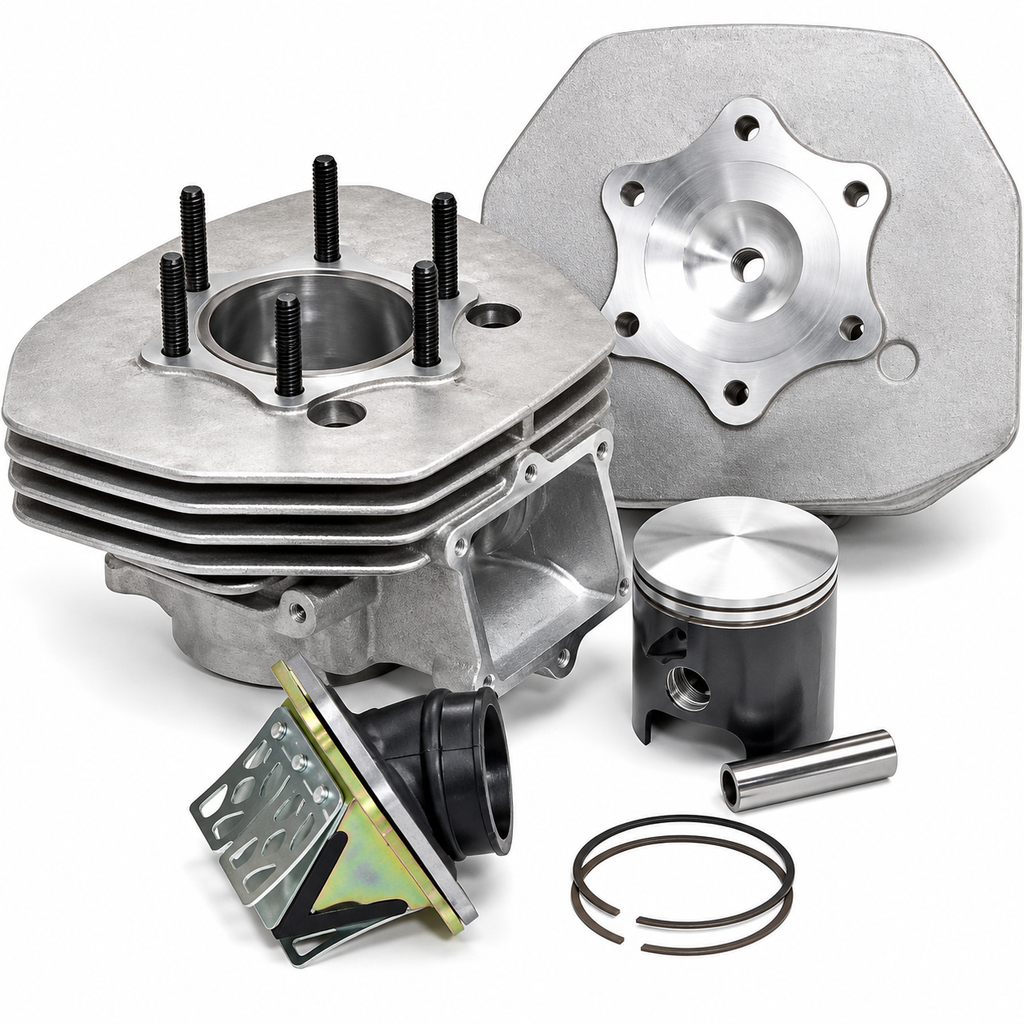
The CT Racing Sonic is one of the most interesting and collectible performance cylinders ever produced for the Yamaha Blaster.
Unlike an OEM cylinder that has simply been bored and ported, the Sonic was designed specifically for racing.
CT Racing offered both a 200cc-class version and a 240cc-class big-bore version.
What makes the CT Sonic different?
The Sonic incorporated several important performance features:
- A dedicated high-performance cylinder casting.
- A larger Honda CR250-style reed cage arrangement.
- A multi-port exhaust design with auxiliary exhaust ports.
- Port geometry designed for substantially increased airflow.
- A design intended to produce high horsepower across a broad power range.
The larger reed arrangement and auxiliary exhaust ports are particularly important identification clues.
CT Racing 66 mm cylinder
The 66 mm version was developed for racing classes with displacement restrictions. It offered the advantages of the Sonic racing design without increasing the bore beyond the standard 200cc class. They are plated cylinders.
This makes it particularly interesting to enthusiasts who want high performance while retaining approximately stock displacement.
CT Racing 72 mm cylinder
The 72 mm Sonic is the larger-displacement version, offering additional capacity and performance potential.
It is one of the most desirable Blaster cylinders for enthusiasts building a period-correct high-performance engine. They’re a 72mm bore with two available oversize pistons.
Are CT Racing Sonic cylinders still available?
No. CT Racing officially lists the Sonic aftermarket cylinders as discontinued.
According to CT Racing, the owner of the foundry that produced the castings passed away, and the original tooling was transferred or sold without CT Racing’s knowledge. CT Racing has stated that it has been unable to locate the tooling.
The company continues to offer work based on factory cylinders, but the original Sonic casting is out of production.
That history is a major reason surviving Sonic cylinders attract attention from serious Blaster enthusiasts.
A usable CT Sonic cylinder, particularly one with its correct head and related components, is worth evaluating carefully before making any irreversible modifications.
3. Airsal cylinders: 66 mm and 71 mm
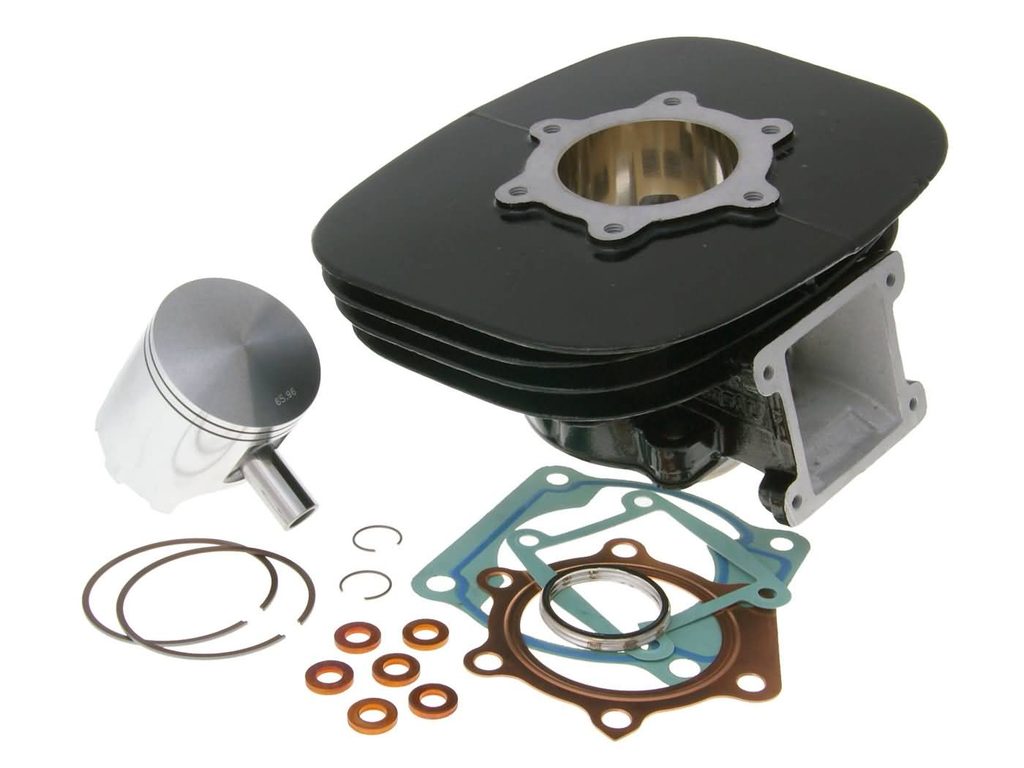
Airsal is a Spanish cylinder manufacturer known for producing aluminum performance cylinders.
Unlike the original Yamaha cast-iron-sleeved cylinder, Airsal cylinders commonly use a plated aluminum bore. This provides a different combination of heat transfer, weight, and service requirements.
Airsal 66 mm cylinder
The 66 mm version retains the original Blaster bore diameter.
Its appeal is the aluminum cylinder construction and potential for improved heat transfer while retaining approximately 195cc displacement.
Identification points include the cylinder’s aftermarket casting, bore construction, and port layout. Look for manufacturer markings, but do not assume that every Airsal cylinder carries the same exterior identification.
Airsal 71 mm cylinder
The larger 71 mm version increases displacement to approximately 226cc with the original crankshaft stroke.
This version is particularly interesting because it offers additional displacement without being the more familiar 72 mm big-bore configuration.
Advantages and disadvantages
Advantages: Aluminum construction, performance potential, and distinctive aftermarket design.
Disadvantages: Plated bores generally require specialist replating rather than conventional oversize boring when worn or damaged. Replacement piston compatibility must also be verified.
Availability: Limited quantities are available from time to time. KOR carries forged pistons for the 66mm version. They’re produced by Wossner.
4. Vito’s Performance 72 mm big-bore cylinder
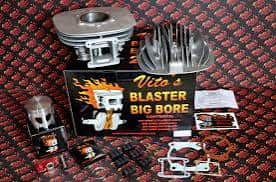
The Vito’s Performance 240 big-bore cylinder has been one of the better-known aftermarket performance options for the Yamaha Blaster.
Unlike a stock cylinder bored to its maximum oversize, the Vito’s cylinder was manufactured specifically to accommodate the larger 72 mm piston.
How to identify a Vito’s cylinder
One of the interesting things about the Vito’s cylinder is that its exterior closely resembles the original Yamaha casting.
Identification clues include:
- A 72 mm nominal bore.
- No original Yamaha Y-1 or Y-2 intake-side casting designation.
- Three exhaust passages, consisting of a main exhaust port and two auxiliary ports.
- Four intake ports, according to Vito’s published specifications.
Some Vito’s castings retain the 195 cm³ exterior marking despite having a 72 mm bore. Therefore, that marking alone does not establish displacement
Performance potential
The larger displacement increases the engine’s potential torque output. The auxiliary exhaust ports also provide additional exhaust flow area compared with the original single-main-exhaust-port arrangement.
However, simply installing a larger cylinder does not guarantee maximum performance. Carburetion, exhaust selection, cylinder porting, head design, and ignition timing all influence the finished engine.
Are Vito’s 240 cylinders still available?
Vito’s still lists its 72 mm cylinder and complete big-bore kits, but the manufacturer currently marks the checked versions as sold out. That does not conclusively establish permanent discontinuation
These cylinders remain desirable among riders who want a traditional big-bore Blaster engine.
5. OEM Yamaha cylinder converted to 72 mm with a big-bore sleeve
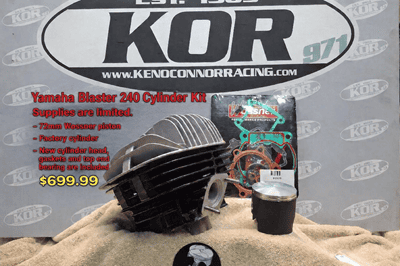
Before complete aftermarket big-bore cylinders became common, one way to increase Blaster displacement was to install a larger cylinder sleeve into the original Yamaha casting.
This is considerably more involved than simply boring the factory cylinder.
How the conversion works
The original sleeve is machined out, the aluminum cylinder casting is machined to accept a larger sleeve, and a new big-bore sleeve is installed.
The cylinder is then finished to the required piston clearance, and the port openings must be correctly machined and blended.
The cylinder head must also be modified for the larger piston diameter and appropriate combustion-chamber geometry.
How to identify one
A sleeved OEM cylinder can look completely stock from the outside.
The original Y-1 or Y-2 marking may still be present, as will the factory displacement marking.
The giveaway is the bore measurement.
If a cylinder has factory Yamaha casting marks but measures approximately 72 mm, it has been converted with a larger sleeve.
Inspecting the cylinder from the top and bottom may also reveal the replacement sleeve and machining.
Advantages and disadvantages
The main advantage is retaining the original Yamaha casting while increasing displacement.
The disadvantages are the amount of machining required.
The quality of the installation deserves attention.
Big bore sleeves are available from Advanced Sleeve, LA Sleeve, and Ken OConnor Racing
A professionally converted OEM cylinder can make an interesting sleeper engine, but it should not automatically be considered superior to a purpose-built aftermarket big-bore cylinder.
6. Chinese replacement Yamaha Blaster cylinders
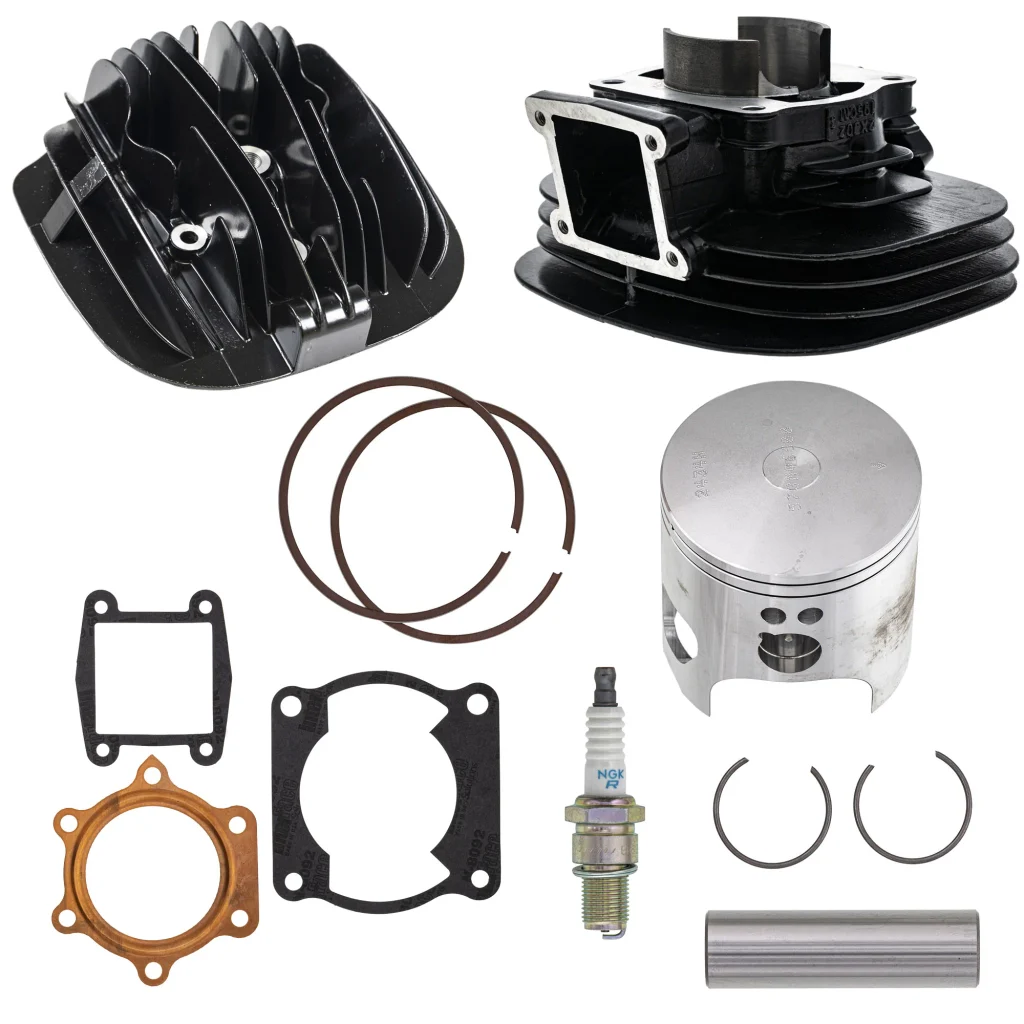
Chinese-manufactured replacement cylinders have become a common alternative to rebuilding an original Yamaha cylinder.
Their biggest attraction is price. Many are sold as complete top-end kits with a piston, rings, wrist pin, bearing, and gaskets.
Although they may look similar to the factory Yamaha cylinder, the similarities can be largely cosmetic.
How to identify a Chinese replacement
Common identification clues include:
- No Y-1 or Y-2 casting designation.
- An exterior closely resembling the OEM cylinder.
- Differences in casting finish and cooling-fin details.
- Rougher or inconsistent port finishing.
- Variations in cylinder sleeve quality and port dimensions, and bore diameter.
However, the absence of Y-1 or Y-2 does not automatically mean a cylinder is Chinese, because some legitimate aftermarket performance cylinders also omit those marks.
KOR’s experience with Chinese cylinders
Back in February 2017, I published an investigation on BlasterForum titled More Info on the Chinese Blaster Cylinder.
Our findings included several concerns:
- Poor-quality pistons, bearings, and gaskets supplied with some kits.
- Softer or potentially porous cylinder liners.
- Differences in port specifications compared with Yamaha OEM.
- Port edges requiring proper chamfering.
- Piston-to-cylinder clearances that needed to be checked and corrected.
The cylinder we examined was also approximately 10 ounces heavier than the original Yamaha cylinder.
We did not simply dismiss it without testing. We rebuilt and modified one with better components, corrected machining, and proper jetting. It performed well during the initial approximately 20 hours of testing.
Blasterforum.com
That was an encouraging short-term result, but it was not proof that the imported cylinder would match OEM Yamaha durability. The KOR modified cylinder was still running great at 90 hours when the Blaster was sold.
Are Chinese cylinders worth buying?
For a budget repair, a properly inspected and corrected aftermarket cylinder is usable.
However, the low initial purchase price can be misleading when the cost of proper machining, quality piston components, gaskets, and inspection is included.
For a serious performance build or a long-term engine rebuild, an original Yamaha cylinder in rebuildable condition is generally the more desirable foundation.
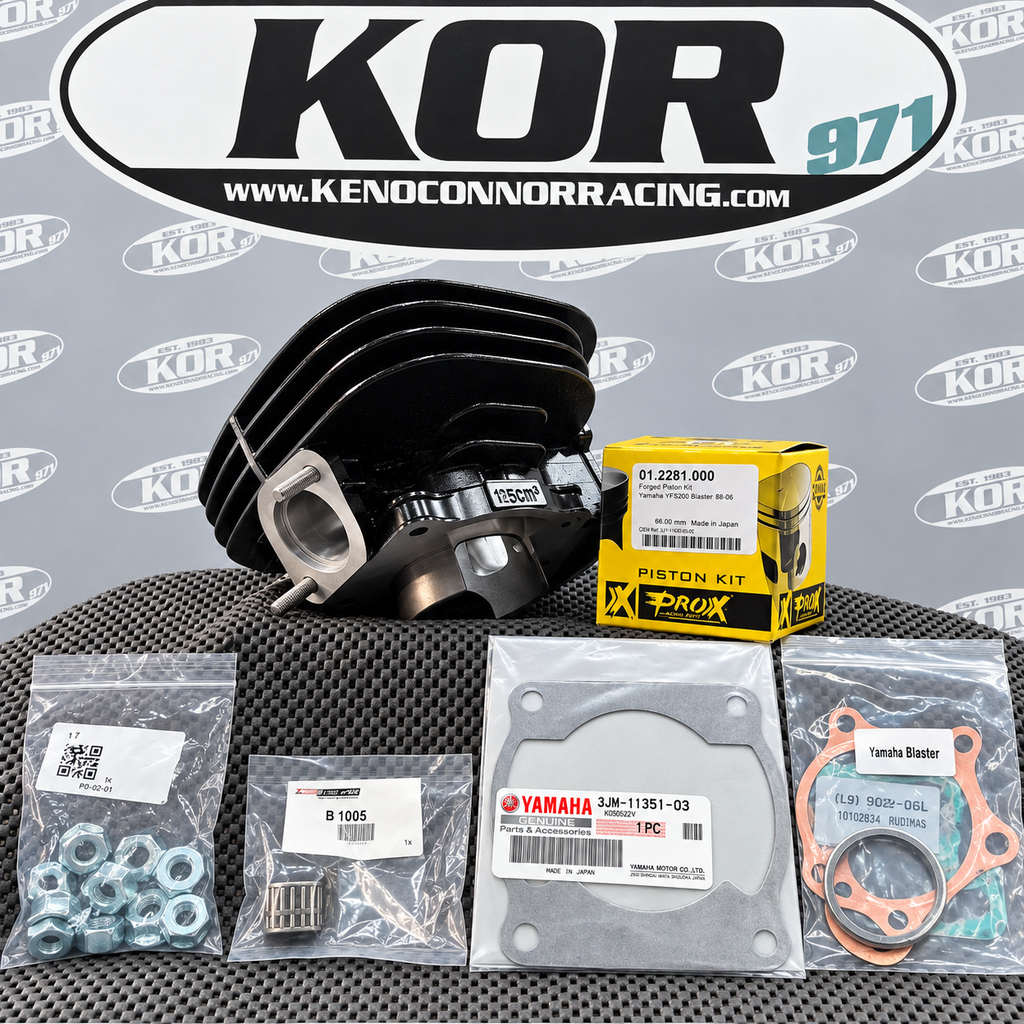
Ken OConnor Racing offers our version of an import cylinder kit. We correct the cylinder clearance and replace the original components. Shop KOR import cylinder kits.
7. Which Yamaha Blaster cylinders are the most desirable?
There is no universal ranking that represents every Blaster rider. Collectors, racers, trail riders, and budget builders value different things.
The following is a practical KOR assessment based on design, rarity, serviceability, and performance potential—not a statistically measured rider-preference survey.
| Cylinder | Desirability | Best suited for |
|---|---|---|
| CT Sonic 72 mm | Extremely high | Collectors, serious performance builds |
| CT Sonic 66 mm | Extremely high | Rare racing builds, period-correct restorations |
| OEM Y-1/Y-2 | Very high | Reliable trail engines, ported performance builds |
| Airsal 71 mm | Specialist interest | Unusual performance builds |
| Vito’s 72 mm | High | Traditional big-bore performance |
| Airsal 66 mm | Specialist interest | Alternative stock-displacement builds |
| Sleeved OEM 72 mm | Depends on workmanship | Sleeper engines, custom builds |
| Chinese replacement | Primarily budget-driven | Economical repairs |
The CT Sonic’s scarcity and distinctive racing design make it a particularly attractive collector’s cylinder.
For most everyday riders, however, a properly machined and ported original Yamaha cylinder is an excellent choice. A stock-displacement engine with correctly designed porting, an appropriate cylinder head, and matched intake and exhaust components can be a very strong-running combination.
The most desirable cylinder is not necessarily the one with the largest bore.
8. How to positively identify an unknown Blaster cylinder
When an unfamiliar cylinder comes into the shop, its appearance is only the beginning of the identification process.
Step 1: Inspect the casting marks
Check the reed-valve intake area for Y-1 or Y-2. Record any other numbers or manufacturer markings.
Step 2: Measure the bore
Use appropriate measuring equipment to establish the actual cylinder diameter. A 72 mm cylinder is not an ordinary overbored OEM sleeve.
Step 3: Inspect the exhaust and intake ports
Count the exhaust passages, examine the intake layout, and look for signs of previous porting. A modified cylinder can be harder to identify.
Step 4: Examine the bore construction
Determine whether the cylinder has an iron sleeve, replacement sleeve, or plated aluminum bore. Inspect for wear, damage, and evidence of repairs.
Step 5: Confirm piston and head compatibility
Never order a piston based only on the exterior appearance or a claimed displacement. Verify bore, piston design, port layout, and head configuration.
9. Final thoughts from Ken OConnor Racing
The Yamaha Blaster has a long history of aftermarket performance development, and some of the cylinders produced over the years have become difficult to find.
The CT Racing Sonic cylinders represent a particularly interesting part of that history. Original Yamaha Y-1 and Y-2 cylinders remain valuable because of their proven construction and rebuild potential. Vito’s, Airsal, and sleeved big-bore cylinders offer different approaches to increasing performance, while inexpensive imported replacements serve a different part of the market.
Whether you’re restoring a Blaster, building a high-performance engine, or simply trying to identify what you purchased, proper inspection and measurement are essential.
At Ken OConnor Racing, we specialize in Yamaha Blaster cylinder boring, honing, porting, cylinder-head modifications, and complete engine rebuilding.
Visit our Yamaha Blaster Parts and Engine Builder page or explore our Mail-In Yamaha Blaster Engine Rebuilding Service.
Ken OConnor Racing — Quality, Service, Price.