
Yamaha Blaster Reed Valves: Boyesen Reeds, RAD Valve vs VForce 4
Ken OConnor Racing | Two-Stroke Engine Technical Information
Yamaha Blaster reed valves play an important role in two-stroke engine performance, controlling the air/fuel mixture entering the crankcase and influencing throttle response, low-end torque, and horsepower.
Upgrading the reed valves is one of the more common modifications made to Yamaha Blaster engines. However, not all reed systems work the same way, and installing more expensive reeds does not automatically produce more horsepower.
This guide explains how reed valves operate, the differences between Boyesen replacement reeds, and how the Boyesen RAD Valve compares with the Moto Tassinari VForce4.
1. How reed valves work in a Yamaha Blaster
The Yamaha Blaster uses a crankcase-reed induction system. Instead of mechanically operated intake valves, flexible reed petals open and close in response to pressure differences between the intake tract and the crankcase.
Piston traveling upward: Intake into the crankcase
As the piston moves upward toward top dead center (TDC), crankcase volume increases. This creates a vacuum, meaning crankcase pressure drops below the pressure in the intake tract.
The higher pressure on the carburetor side of the reeds pushes the reed petals open, allowing the air/fuel mixture to flow into the crankcase.
Piston traveling downward: Crankcase compression
As the piston moves downward toward bottom dead center (BDC), crankcase volume decreases and pressure increases.
When crankcase pressure exceeds intake tract pressure, the reed petals close, preventing the air/fuel mixture from flowing backward through the carburetor.
The descending piston compresses the mixture in the crankcase. Once the transfer ports are uncovered, the pressurized mixture flows into the cylinder.
An important distinction: The vacuum does not physically pull the reeds open. The reeds open because of the pressure difference across the petals.
2. Why reed valve design matters
Reed petals must open and close rapidly while maintaining an effective seal.
At 6,000 RPM, the Yamaha Blaster completes 100 crankshaft revolutions per second. Reed movement is influenced by rapidly changing intake and crankcase pressures.
Several factors affect reed performance:
- Reed stiffness: More flexible reeds generally open with smaller pressure differences, while stiffer reeds can provide better control under higher pressure loads.
- Reed material: Fiberglass and carbon-fiber materials have different stiffness, fatigue, and response characteristics.
- Reed thickness: Influences the force required to open the petals and their natural vibration characteristics.
- Reed cage geometry: Determines the available flow area and how the mixture travels through the assembly.
- Reed sealing: Damaged or poorly seated reeds can allow reverse flow, affecting starting, idle, and throttle response.
A reed system must balance responsiveness, airflow, sealing, and durability.
3. Boyesen reed options for the Yamaha Blaster
Boyesen Super Stock Reeds
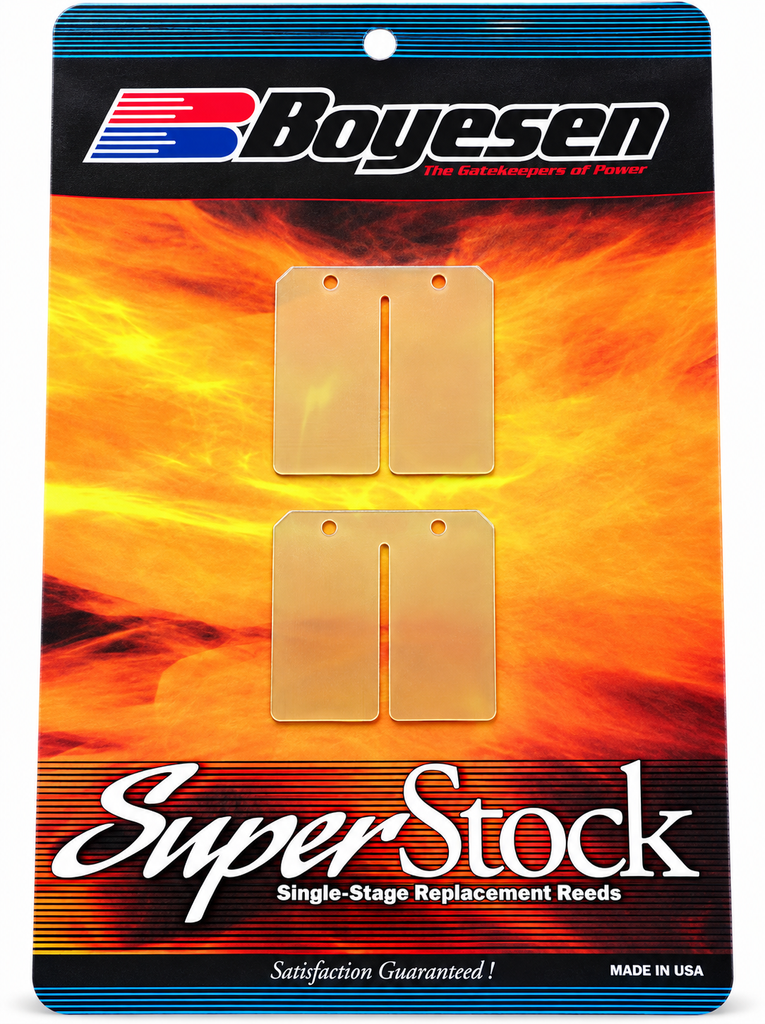
Boyesen Super Stock reeds are intended as replacement reeds for compatible original-equipment reed cages.
Their primary purpose is to provide dependable reed operation without replacing the entire intake assembly.
Advantages: Economical replacement, straightforward installation, and suitable for stock engine maintenance.
Disadvantages: Retains the original reed cage geometry and generally offers less opportunity for performance improvement than a redesigned reed system.
Best application: Stock Yamaha Blasters requiring replacement reed petals. Order Yamaha Blaster Boyesen Super Stock Reed Petals
Boyesen Power Reeds
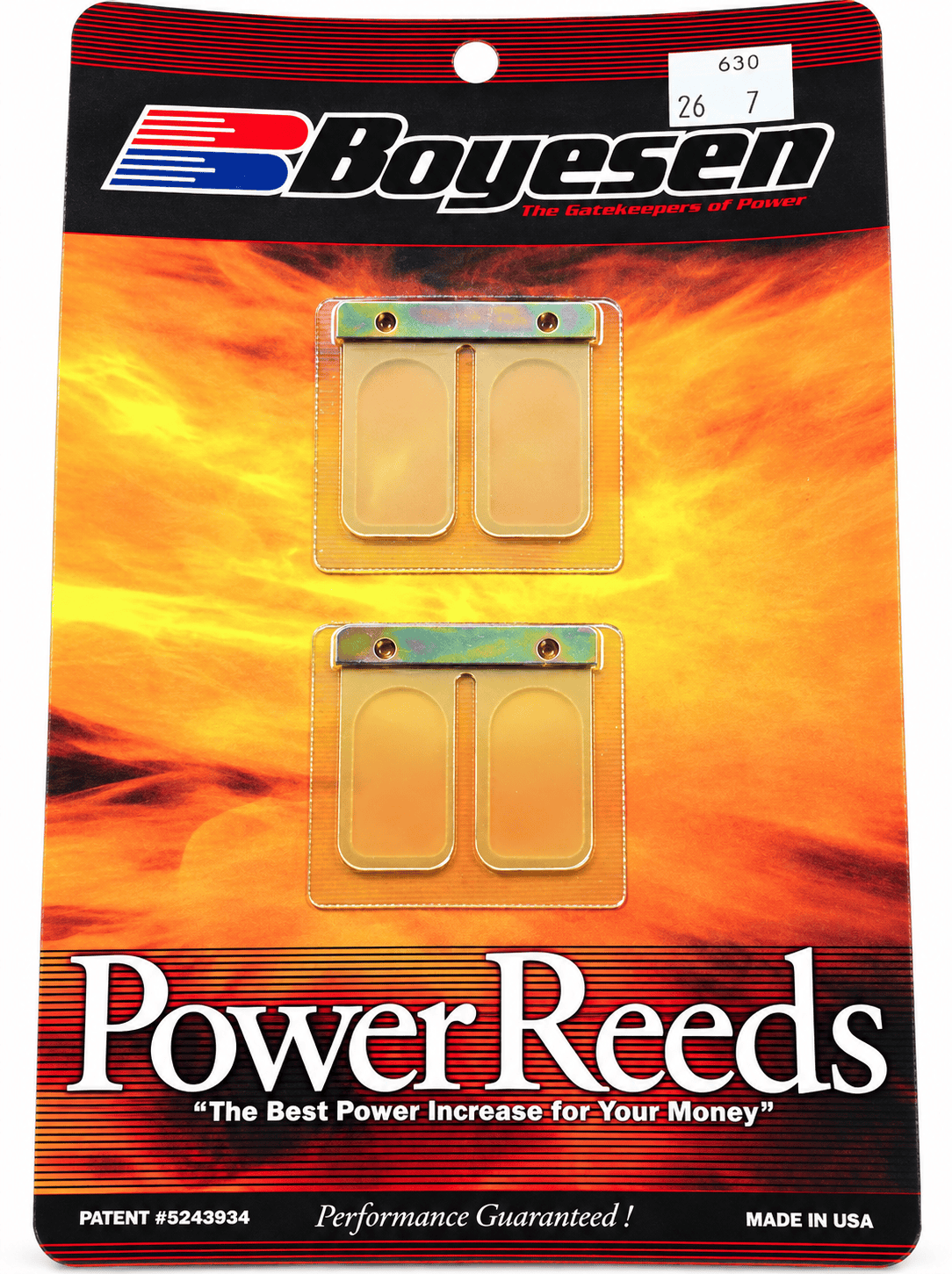
Boyesen Power Reeds use a dual-stage design with two layers of reed material.
The thinner upper petals respond to relatively small pressure differences. As engine airflow demand increases, the ported lower reeds provide additional flow capability.
This arrangement is designed to improve response over a broad RPM range.
For the Yamaha Blaster, Boyesen Power Reeds are commonly listed under part number 630.
Advantages: Improved response potential, broad power delivery, affordable performance upgrade, and compatibility with the stock reed cage.
Disadvantages: Retains the original cage’s flow characteristics, and performance gains may be modest on an otherwise stock engine with properly functioning reeds.
Best application: Stock and mildly modified Blasters, especially trail-riding combinations. Order Yamaha Blaster Boyesen Power Reed Petals
Boyesen Pro Series Reeds
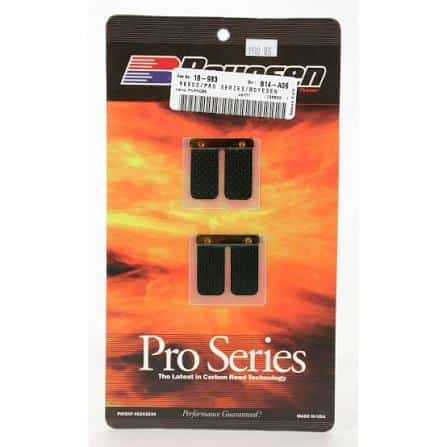
Boyesen Pro Series reeds use performance-oriented materials and dual-stage reed technology.
Compared with conventional fiberglass Power Reeds, Pro Series designs emphasize carbon-fiber reed response and controlled operation at elevated engine speeds.
Advantages: Lightweight reed construction, responsive operation, and performance-oriented design.
Disadvantages: Higher cost than basic replacement reeds and no change to the stock cage geometry when used as a petal-only replacement.
Best application: Performance engines that live in the higher RPM range. Order Yamaha Blaster Boyesen Pro Series Reed Petals
4. Boyesen RAD Valve: A complete reed system
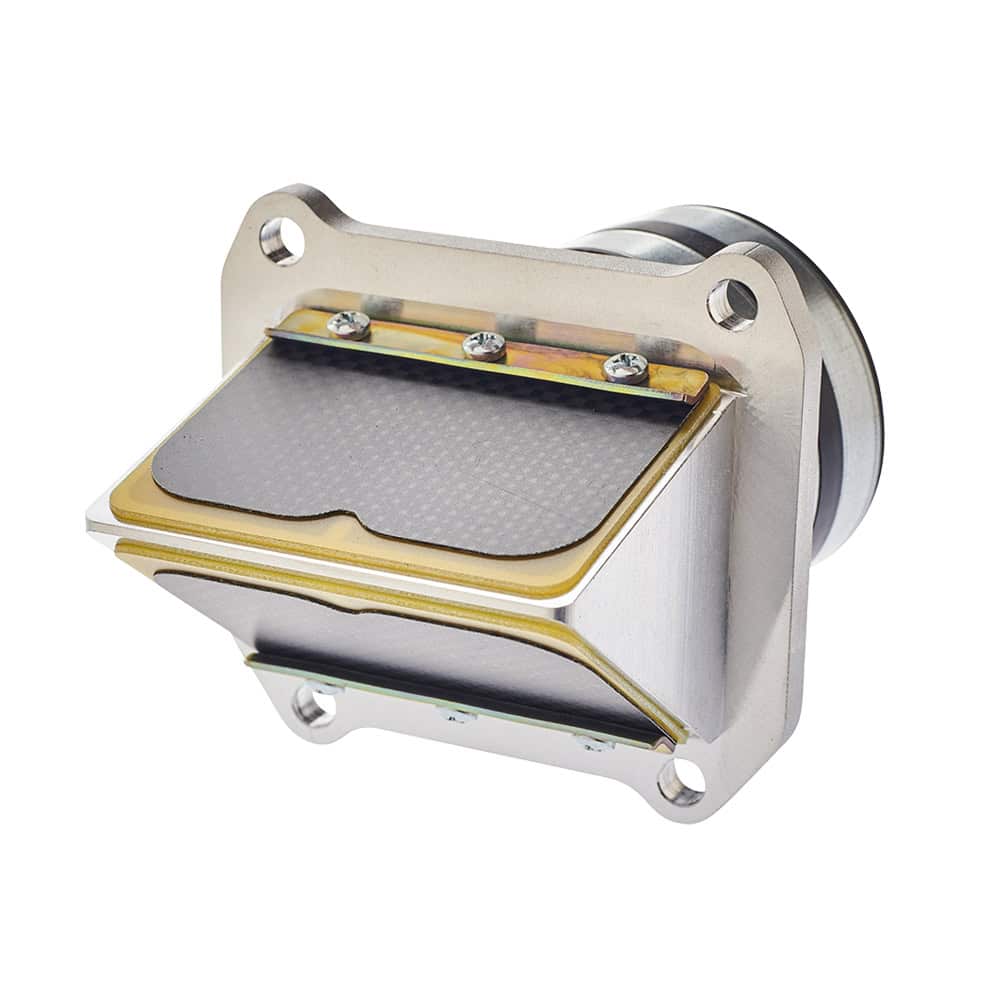
The Boyesen RAD Valve is not simply a set of replacement reeds.
It is a complete reed valve assembly designed to replace the original Yamaha Blaster reed cage.
The Yamaha Blaster application is commonly identified as RAD35A.
The RAD Valve combines a specially shaped intake passage with multi-stage carbon-fiber reeds.
Its internal geometry is designed to manage airflow through the reed assembly, while the dual-stage reeds respond to changing intake pressure conditions.
Advantages of the RAD Valve
- Replaces the complete stock reed cage.
- Uses multi-stage reed technology.
- Incorporates specially shaped intake passages.
- Designed for improved throttle response and mixture flow.
- Can complement stock and modified engine combinations.
- Replacement reeds are available.
Disadvantages of the RAD Valve
- More expensive than replacement reed petals.
- Uses RAD-specific replacement reeds. Order Yamaha Blaster Rad Valve Replacement Reed Petals
- Potential performance gains depend on engine modifications.
- May require carburetor jetting adjustments.
- Does not guarantee higher horsepower than competing reed systems.
The RAD Valve is an attractive option for riders looking for a complete intake upgrade rather than simply replacing the stock reeds. Order Yamaha Blaster Boyesen Rad Valve
5. Moto Tassinari VForce4 Reed Valve
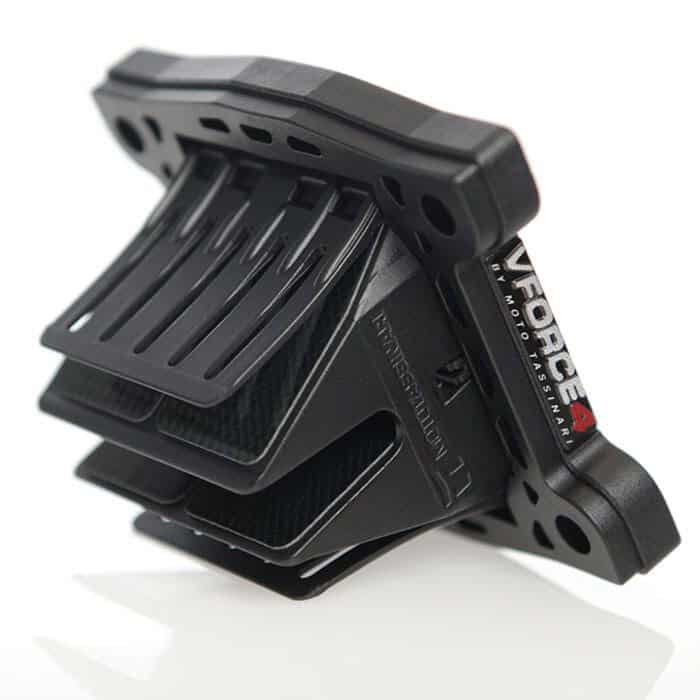
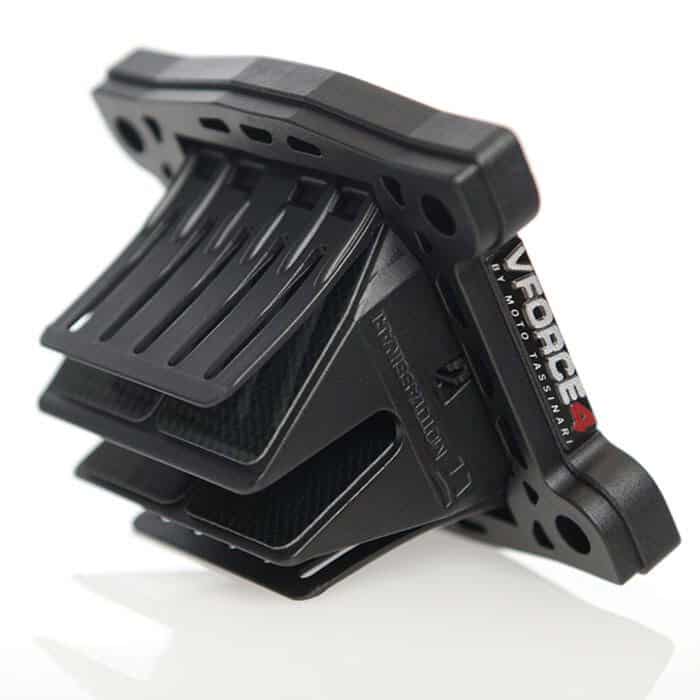
The Moto Tassinari VForce4 takes a different approach to reed valve design.
Instead of a conventional reed arrangement, the VForce4 uses multiple reed surfaces positioned in a V-shaped configuration.
This provides a greater effective reed opening area within the assembly.
With more available reed area, the individual petals can potentially open a shorter distance to provide a given amount of airflow.
The VForce4 also uses pre-curved carbon-fiber reeds and specially designed reed cage surfaces.
Advantages of the VForce4
- Large effective reed opening area.
- Multiple reed surfaces.
- Carbon-fiber reed construction.
- Designed to improve throttle response and intake flow.
- Potential advantages on engines with increased airflow demand.
- Replacement reeds are available.
Disadvantages of the VForce4
- Higher cost than basic reed upgrades.
- Multiple petals require inspection and maintenance.
- Greater reed area does not automatically increase horsepower.
- Performance depends on engine configuration and tuning.
- Requires application-specific replacement parts. Order Yamaha Blaster Genuine V-Force Reed System.
6. Boyesen RAD Valve vs. VForce4: Direct comparison
VForce4
| Feature | Boyesen RAD Valve | VForce4 |
|---|---|---|
| Reed design | Multi-stage | Multiple reed surfaces |
| Cage design | Shaped intake passage | V-shaped arrangement |
| Main emphasis | Flow management and reed response | Effective reed area |
| Reed material | Carbon-fiber-based | Carbon fiber |
| Throttle response | Designed to improve | Designed to improve |
| High-RPM potential | Application-dependent | Application-dependent |
| Replacement reeds | RAD-specific | VForce-specific |
| Installation | Complete assembly | Complete assembly |
Which is better for low-end torque?
The Boyesen RAD Valve’s multi-stage design is intended to respond well to changing intake pressures, including those encountered at lower engine speeds.
The VForce4 also aims to provide responsive operation through its multiple reed surfaces.
Both can work well in trail-riding applications. Without back-to-back testing, it would be inaccurate to declare either system the winner for low-end torque on every Yamaha Blaster.
Which is better for high-RPM horsepower?
The VForce4’s increased reed opening area may be advantageous when an engine demands more airflow.
However, the Boyesen RAD Valve also provides a redesigned intake passage intended to improve flow efficiency.
The engine’s cylinder porting, exhaust system, carburetor, and operating RPM determine how much benefit either system can provide.
A reed valve cannot compensate for an exhaust system or cylinder porting combination that limits engine performance.
Which is more durable?
Both systems use performance-oriented reed materials.
Actual service life depends on operating RPM, reed condition, engine modifications, and maintenance.
Neither system should be assumed to last longer without controlled durability testing.
7. Which reed system should you choose?
| Engine combination | Recommended starting point |
|---|---|
| Stock engine, routine maintenance | Compatible Super Stock replacement |
| Stock engine, affordable upgrade | Boyesen Power Reeds |
| Mild trail build | Power Reeds or complete reed assembly |
| Trail-ported engine | RAD Valve or VForce4 |
| Aggressive trail build | RAD Valve or VForce4 |
| High-RPM race engine | Test both complete assemblies |
For most stock Yamaha Blaster owners, a properly functioning set of Boyesen Power Reeds may provide the best balance between cost and potential improvement.
For engines with performance exhaust systems, cylinder porting, modified cylinder heads, and larger carburetors, complete aftermarket reed assemblies become more attractive.
The best choice depends on the intended powerband rather than simply selecting the system with the largest advertised flow area.
What are Blaster riders saying?
The VForce 4 appears to be the more popular recommendation among Yamaha Blaster enthusiasts, particularly for throttle response and broad power delivery. However, there isn’t enough reliable back-to-back dyno evidence to claim it produces more peak horsepower than the Boyesen RAD Valve.
8. Will changing reeds require rejetting?
Changing reed valves can affect the airflow and pressure signals that influence carburetor operation.
This does not mean every reed upgrade requires a larger main jet.
After installing a different reed system, the carburetor should be evaluated throughout the throttle range.
Pay particular attention to low-speed response, needle calibration, main jet requirements, and any signs of lean operation.
The engine should also be checked for intake leaks before tuning.
For the stock Mikuni VM26 carburetor, Ken OConnor Racing provides jetting information and calculators to help establish initial settings. Final calibration must be verified on the actual engine.
9. Inspecting and maintaining reed valves
Reed petals are wear items and should be inspected during engine servicing.
Look for chipped edges, cracks, delamination, damaged mounting hardware, and petals that fail to seat correctly.
Damaged reeds can contribute to hard starting, poor idle quality, hesitation, and excessive intake spitback.
However, those symptoms can also result from incorrect carburetor calibration, crankcase air leaks, ignition problems, or low compression.
Reed valves should be evaluated as part of the complete engine system rather than assumed to be the cause of every running problem.
10. Final conclusion
Boyesen Power Reeds, the Boyesen RAD Valve, and Moto Tassinari VForce4 all offer different approaches to controlling intake flow in the Yamaha Blaster.
Power Reeds provide an affordable dual-stage upgrade while retaining the original reed cage.
The Boyesen RAD Valve combines multi-stage reeds with a redesigned intake passage.
The VForce4 uses multiple reed surfaces to increase effective opening area and manage airflow.
Both complete systems have advantages, but neither is automatically the best choice for every engine.
For a stock Blaster, the improvement from a complete reed valve assembly may be relatively modest. As cylinder porting, carburetor size, and exhaust performance increase, reed valve selection can become more important.
At Ken OConnor Racing, our approach is to match the components to the intended application. Proper cylinder porting, head configuration, exhaust selection, and carburetor tuning must work together to produce a strong, reliable engine.
Quality, Service, Price.
Ken OConnor Racing — Full Engine Machine Shop. All Services Performed On Site.Visit Ken OConnor Racing